
Quick answers
What to know before the next decision
How common is this?
About 1 in 10 men who have tissue removed for BPH turn out to have cancer in it: roughly 10% after TURP, 9% after HoLEP and 11% after open simple prostatectomy in a pooled analysis of 94,783 patients. Recent robotic simple prostatectomy series report 2% to 13%. Procedures that remove little or no tissue (UroLift, Rezum, Aquablation) cannot find cancer this way.
Is it serious?
Usually small and low grade, and many men never need treatment. But not always. In a Danish national study, men with incidental Grade Group 1 cancer had an 8.4% chance of dying from prostate cancer within 15 years, and 14% for Grade Group 2, likely because higher-grade cancer in the outer prostate went unsampled. Men whose follow-up biopsy found no cancer had a 0.6% chance.
What happens next?
A PSA test after the prostate heals, often an MRI of the remaining prostate, and sometimes a biopsy of it. With a low grade, a small amount of cancer and a low PSA, active surveillance is the usual plan. With more cancer, a higher grade or a PSA that stays up, treatment is discussed.
What the report is describing
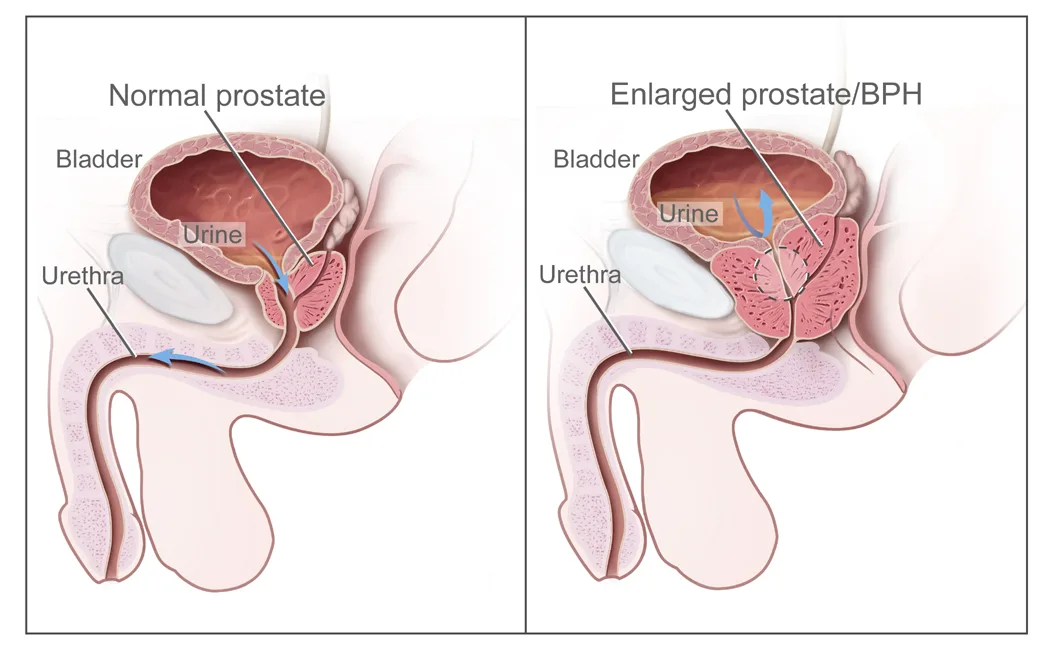
BPH surgery (TURP, HoLEP, or simple prostatectomy, open or robotic) removes the inner part of the prostate so urine can pass. The tissue goes to a pathologist. When cancer turns up that nobody suspected, it is called incidental prostate cancer.
The report gives three things. The Grade Group (1 to 5) says how aggressive the cells look; Grade Group 1 is the most common finding here. The percent of tissue with cancer sets the stage: T1a is 5% or less, T1b is more than 5%. The specimen weight says how much tissue was removed. Ask for the report itself, not a summary.
Why the operation did not answer the cancer question
Most prostate cancers start in the outer zone of the prostate. BPH surgery removes the inner zone. Cancers that live only in the inner zone are 2% to 7% of all prostate cancers. So the cancer in the specimen may be the edge of a larger cancer in the tissue left behind, or it may be all there was.
That is why follow-up matters. In the Danish registry, about a third of men with incidental cancer had an MRI or biopsy within five years. Of 270 men with Grade Group 1 who had a biopsy, 60% had no cancer found, and their 15-year prostate cancer mortality was 0.6%. Men whose biopsy showed Grade Group 2 or higher had a 30% mortality. The tests sort men into those groups.
The PSA after surgery is the key number
Most of the PSA-making tissue is gone, so PSA should fall to a new low. A low PSA after surgery suggests little or no cancer remains. A PSA that stays higher than expected suggests cancer in the outer zone. In one review, men with PSA under 2 before surgery and under 1 afterward had the best chance of no remaining cancer, and a PSA above 1 after surgery was the least likely to mean the cancer was gone.
A French series listed five warning signs: PSA of 10 or more before surgery, PSA of 2 or more after, prostate weight of 60 g or more, 40 g or more removed, and Gleason 6 or higher. Two or more of these went with a higher chance of progression. Ask what PSA your urologist expects and when it will be drawn.
MRI and biopsy: when each one helps
An MRI looks at the outer zone that was left in place. A clear MRI with a low PSA density (PSA divided by prostate size, 0.08 or less in one review) is a combination urologists use to feel comfortable watching. A suspicious area is a reason to biopsy it.
A biopsy of the remaining prostate is most useful when its result would change the plan: before committing to surveillance, or when PSA stays up or the MRI shows something. It is not automatic. In one study a biopsy changed the grade in only 14% of men.
Active surveillance: when watching is the plan
The AUA and ASTRO guideline recommends active surveillance as the preferred option for low-risk prostate cancer. For cancer found at BPH surgery, that usually means Grade Group 1, T1a, a low PSA after surgery and a clear MRI. In a six-center robotic simple prostatectomy series, men with Grade Group 1 to 3 cancer were followed this way.
Surveillance is a schedule, not an absence of care: PSA at set intervals, exams, and a repeat MRI or biopsy if anything changes. Ask what change would trigger a treatment discussion, and who tracks the schedule.
When treatment is advised, and what the options are
Treatment is usually discussed for T1b, Grade Group 2 or higher, a PSA that stays up, or a biopsy that finds more cancer, especially for men expected to live more than 10 more years.
Radical prostatectomy can still be done after BPH surgery, including robotically, though scar tissue makes it harder. After HoLEP, a review of three studies found about 32 extra minutes of surgery and more bladder neck repairs, with no difference in cancer control, margins, continence or erections. Ten-year cancer control after prostatectomy has been reported at 79% to 98% for T1a and 74% to 88% for T1b.
Radiation is an accepted option after BPH surgery, with long-term urinary side effects similar to men without prior surgery in most reports and a small added risk of leakage (2% versus 0.2% in one series). Hormone therapy is generally reserved for men who cannot have or do not want surgery or radiation, or when cancer has spread. For an older man with other health problems and a low-grade finding, PSA checks alone may be the right plan.
Frequently asked questions
Cancer found after BPH surgery: questions, answered
Did the BPH operation remove the cancer?
You cannot assume so. The operation removed the inner zone; most cancers start in the outer zone, which is still there. A low PSA after surgery and a clear MRI make it more likely that little or nothing remains.
What is the difference between T1a and T1b?
Both are cancers found by chance in BPH tissue. T1a means cancer in 5% or less of the tissue; T1b means more than 5%. T1b is treated more often, especially in men expected to live more than 10 years.
Do I need another biopsy?
Sometimes. A biopsy of the remaining prostate helps most when it would change the plan, such as before choosing surveillance or when PSA stays up. In one study it changed the grade in only 14% of men, so it is not routine for everyone.
Can I still have a prostatectomy after HoLEP or TURP?
Yes. It is technically harder because of scar tissue, and surgery takes longer, but studies show no difference in cancer control, continence or erections compared with men who had no prior surgery. Ask how often your surgeon operates after prior prostate surgery.
What if I had UroLift, Rezum or Aquablation?
Those procedures remove little or no tissue for a pathologist, so cancer is not found this way. Cancer can still be found later through PSA testing, MRI and biopsy, the same way as for any man.
Bring these questions
Make the next appointment concrete.
- What is my Grade Group, what percent of the tissue had cancer, and what did the specimen weigh?
- When will my first PSA after surgery be drawn, and what number would you expect?
- Do I need an MRI of the remaining prostate, and when?
- Would a biopsy change the plan, or can we decide without one?
- If we watch, what is the schedule and what would trigger treatment?
- If we treat, why that option for my age and health?
Sources and further reading
These primary references support the educational guide reviewed by Domenico Savatta, MD on October 12, 2026. They do not replace guidance from your own clinician.
- EAU Guidelines on Prostate Cancer (2026): Classification and Staging Systems, TNM tableDefines T1a (5% or less of resected tissue) and T1b (more than 5%).
- Guo Z et al. Incidental prostate cancer in surgeries for benign prostatic hyperplasia: systematic review and meta-analysis. Int Braz J Urol 2022Pooled rates by operation: TURP about 10%, HoLEP 9%, open prostatectomy 11%; higher PSA the only independent predictor.
- Ramos-Carpinteyro R et al. Incidental prostate carcinoma after single-port robot-assisted simple prostatectomy (SPARC). Minerva Urol Nephrol 2024235 robotic simple prostatectomies: 4.6% incidental cancer, 2.1% clinically significant, Grade Group 1 to 3 followed with surveillance.
- Farzat M et al. Incidental prostate cancer: is PSA density a valid predictor? A case-control study of robot-assisted simple prostatectomy. Ther Adv Urol 2025100 robotic simple prostatectomies: 8% incidental cancer; a prior negative biopsy was the strongest predictor.
- Shvero A et al. Incidental prostate cancer at holmium laser enucleation of prostate. Can J Urol 2021777 HoLEP patients: 7.1% incidental cancer, 62% Grade Group 1.
- Leni R et al. Management and Oncologic Outcomes of Incidental Prostate Cancer After TURP in Denmark. J Urol 2024Danish national data on follow-up and 15-year prostate cancer mortality after incidental cancer at TURP.
- Abedi AR et al. The Management of Patients Diagnosed with Incidental Prostate Cancer: Narrative Review. Res Rep Urol 2020PSA before and after surgery as predictors of remaining cancer; surveillance criteria; surgery and radiation outcomes.
- Perera M et al. Incidental prostate cancer in TURP specimens in men aged up to 65 years. Prostate Int 2016Inner-zone-only cancers are 2% to 7% of prostate cancers.
- Ditonno F et al. Impact of prior HoLEP on robot-assisted radical prostatectomy outcomes: systematic review and meta-analysis. J Endourol 2026Robotic prostatectomy after HoLEP: longer surgery, more bladder neck repairs, same cancer and functional outcomes.
- AUA/ASTRO Guideline: Clinically Localized Prostate Cancer (2022, amended 2026)Active surveillance as the preferred management for low-risk prostate cancer.
- National Cancer Institute: Prostate Cancer Treatment (PDQ), patient versionTreatment options overview for patients.