
Build the full estimate
One online number cannot show the whole bill.
A price posted online may describe only one service. A prostate-biopsy estimate can involve the procedure, a facility or office, anesthesia, pathology, imaging, and separate professional charges. Before comparing totals, ask what each number includes and excludes.
The planned route and targeting method, place of service, network status, prior-authorization or medical-necessity rules, deductible, coinsurance, and remaining out-of-pocket maximum can all affect the amount a patient is asked to pay. No public benchmark can calculate those details for one person.
The five-layer bill stack
Open every layer before comparing estimates.
Each layer can create a separate question, estimate, or bill. Open and close the layers to keep the right question with the right billing party.
Bill layer 01Procedure and approach
The planned biopsy route, targeting method, and sampling work may not map to the same billed service. Start with the procedure the clinical team actually plans to perform.
AskWhat exact procedure and 2026 billing code are planned?
Bill layer 02Facility or office
An office, ambulatory surgery center, and hospital outpatient department can involve different professional and facility billing arrangements.
AskWhere will it happen, and will a separate facility bill apply?
Bill layer 03Anesthesia
Local pain control, sedation, and anesthesia services may involve different people and separate billing. Confirm the plan before relying on a procedure-only estimate.
AskWhat pain-control or sedation plan is expected, and who bills for it?
Bill layer 04Pathology
The laboratory that processes the samples and the pathologist who interprets them may bill separately from the urology office or facility.
AskWhich laboratory and pathologist will process and interpret the samples, and are they in network?
Bill layer 05Imaging and targeting
Prior MRI, image-fusion work, ultrasound guidance, or another imaging service may sit outside the procedure amount shown in an online price.
AskIs prior MRI, image fusion, ultrasound guidance, or another imaging service billed separately?
Current billing context
The 2026 code question
Because 2026 introduced approach-specific prostate-biopsy billing changes, an older page that names one generic code may not match the planned service. Do not choose a code from an online list. Ask the billing office to identify the current code for the exact approach and setting after the clinical plan is established.
Please give me the exact 2026 billing code, place of service, and services expected to be billed separately for the biopsy my clinician has planned.
Three payment lanes
Use the lane that matches how the care will be paid.
Original Medicare
Use the exact planned service and setting when checking current Medicare tools. A lookup result is one planning input; it does not assemble every possible bill or determine an individual's final out-of-pocket amount.
Confirm- The exact 2026 procedure code and place of service
- Whether professional, facility, anesthesia, pathology, imaging, or laboratory services may be separate
- Whether the person has Original Medicare or a Medicare Advantage plan with its own network and authorization rules
Commercial insurance
Build the estimate from the plan's current benefits and network rules plus written estimates from the parties that may bill. A quote from one office is not necessarily an all-in amount.
Confirm- Prior authorization, referral, and medical-necessity documentation requirements
- In-network status for the urologist, facility, anesthesia group, pathology laboratory, and imaging provider
- Remaining deductible, coinsurance, and out-of-pocket maximum under the current plan year
Self-pay or uninsured
Request an itemized written estimate from each provider or facility expected to bill. If insurance will not be used for the care, the federal Good Faith Estimate process may apply.
Confirm- Every expected billing party and the legal name that will appear on the bill
- Which services, professional fees, tests, or complications are excluded from each estimate
- Available financial-assistance or payment-policy information without assuming eligibility
Build the estimate before the appointment
Eight questions. One written checklist.
Work from the procedure plan outward. Record the name of the person who answers each question and the date of the answer.
- 01Urology office
What exact biopsy approach and billing code are planned in 2026?
- 02Urology office
Is the procedure in an office, ambulatory surgery center, or hospital outpatient department?
- 03Every billing office
Which professional, facility, anesthesia, pathology, imaging, and laboratory bills should I expect?
- 04Insurer and billing offices
Is every billing party in network, including the pathology lab and anesthesia group?
- 05Insurer
Does my plan require prior authorization, a referral, or medical-necessity documentation?
- 06Insurer
What remains on my deductible, coinsurance, and out-of-pocket maximum?
- 07Procedure coordinator
What is the written all-in estimate, and which services are excluded from it?
- 08Every provider or facility
If I am uninsured or not using insurance, how do I request a Good Faith Estimate from every involved provider or facility?
Estimate rights
Good Faith Estimate rights
CMS says that, usually, when a person is not using health insurance to pay for scheduled care, a provider must give a Good Faith Estimate when one is requested or when services are scheduled at least three business days in advance.
One estimate may cover only one provider or facility, so more than one estimate may be needed. Separately scheduled services, another provider's services, or unanticipated care may not appear. Treat the estimate as an itemized planning document, not a promise that no other charge can occur.
- Tell each billing office that you are uninsured or will not use insurance for the scheduled care.
- Request a written, itemized estimate from every provider or facility expected to bill.
- Compare the named services, expected charges, billing entities, and anything listed as excluded or unknown.
Medical decision boundary
Keep the medical decision separate
Price should not decide whether a biopsy is medically appropriate or how it is performed. Cost planning starts after the clinician explains which options are medically reasonable for the individual situation.
The biopsy route, targeting method, anesthesia plan, infection and urinary-retention risks, prior results, and clinical appropriateness belong in the medical discussion. Use the estimate to understand the billing plan, then take unresolved medical questions back to the responsible clinician.
Quick answers
What to know before the next decision
Why is a prostate biopsy done?
It is used to determine whether sampled prostate tissue contains cancer and, when cancer is found, to report features such as Grade Group that help guide the next discussion.
Is a prostate biopsy painful?
Experiences vary by route, anesthesia, and individual factors. The team should explain the numbing or sedation plan, what sensations to expect, and how discomfort will be managed.
Is MRI better than biopsy?
They answer different questions. MRI estimates imaging suspicion and can guide targeting; biopsy provides tissue for a pathologist. A non-suspicious MRI does not always remove the need for biopsy.
When a prostate biopsy enters the decision
A biopsy may be discussed when the combined evidence suggests enough risk of clinically significant prostate cancer to justify tissue sampling. That evidence can include a confirmed PSA pattern, PSA density, exam findings, MRI, a validated biomarker, family or inherited risk, and prior biopsy history.
One PSA value or one MRI label should not be treated as the entire decision. Ask the clinician to state the estimated concern, what has already been checked, what reasonable alternatives exist, and what the biopsy result would change.
What biopsy adds that PSA and MRI cannot
PSA and other blood or urine tests estimate risk. MRI can identify and locate suspicious areas. A biopsy samples tissue so a pathologist can determine whether cancer is present in those cores and, if so, describe grade and other findings that inform risk.
Biopsy still has sampling limits because it examines selected cores rather than every cell in the prostate. The sampling plan, MRI targeting, pathology quality, and follow-up after a benign result all matter.
Build the procedure plan before the appointment
Confirm the biopsy route, anesthesia or sedation, whether MRI findings will be targeted, whether systematic samples are also planned, and how many targets are being sampled. Ask whether you will need a driver and which activity restrictions apply afterward.
Give the team a complete list of prescription medicines, over-the-counter drugs, and supplements, plus allergies, prior infections, urinary symptoms, and earlier biopsy complications. Do not stop a blood thinner, aspirin, antibiotic, or any prescribed medicine unless the responsible clinician gives specific instructions.
Transperineal and transrectal routes
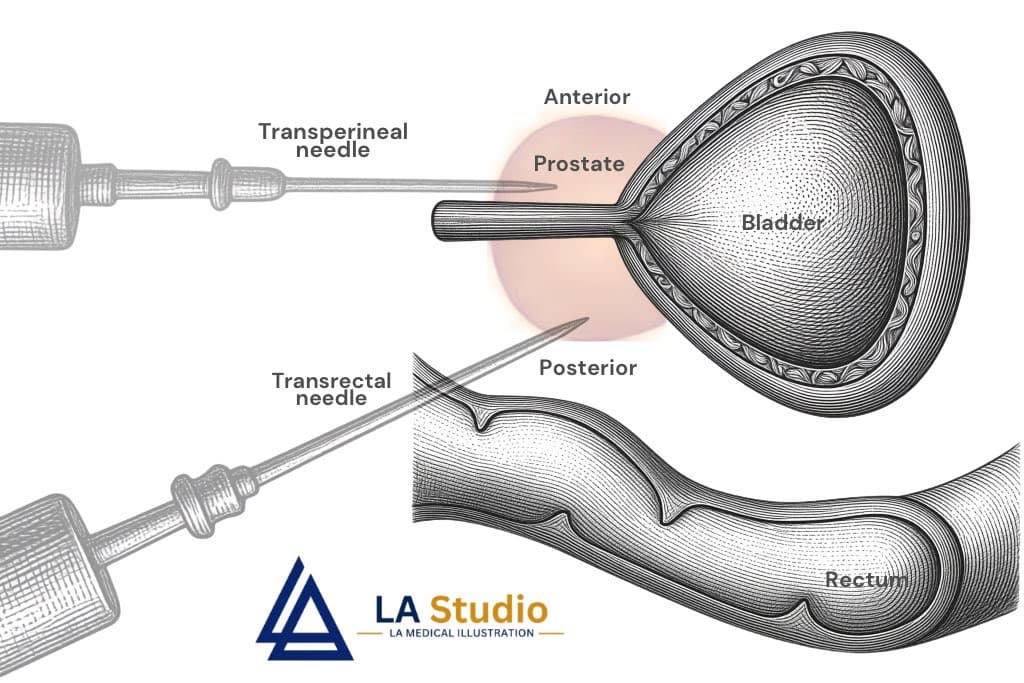
A transperineal biopsy passes needles through the skin between the scrotum and anus. A transrectal biopsy passes needles through the rectal wall. AUA/SUO guidance allows either route; technique, anesthesia, infection planning, lesion location, equipment, and team experience can influence the choice.
Current evidence suggests similar overall cancer-detection rates between routes, while infection patterns and access to some prostate areas may differ. Ask why the recommended route fits your anatomy and risk, and what the team does to reduce infection, bleeding, urinary-retention, and pain risks.
Targeted, systematic, or combined sampling
If MRI shows a suspicious lesion, the biopsy can target that area using image-fusion software, cognitive targeting, or another guidance method. Systematic biopsy takes samples from a planned distribution across the prostate, including areas that may not appear suspicious on MRI.
Depending on the clinical situation, the plan may use targeted samples, systematic samples, or both. Ask whether the approach could miss an area of concern and how the result will be interpreted if MRI and pathology do not agree.
What recovery can include—and when to call
Temporary soreness and some blood in urine, stool, or semen can occur after biopsy; the expected pattern and duration depend on the route and the individual. Follow the procedure team's written instructions about activity, medicines, hydration, and when to resume normal routines.
Contact the procedure team promptly for fever or chills, inability or increasing difficulty urinating, prolonged or heavy bleeding, worsening pain, or any symptom listed in the discharge instructions. Know the daytime and after-hours contact before leaving the facility.
Plan the pathology conversation before the procedure
Confirm when pathology is expected, where the report will appear, who will explain it, and when that conversation is scheduled. A useful review covers whether cancer was found, Grade Group and Gleason information when applicable, how many cores were involved, how much tissue was involved, and whether MRI and pathology findings match.
A benign biopsy is reassuring for the sampled tissue but may not end follow-up when PSA, MRI, or another risk signal remains concerning. An abnormal but noncancerous finding may also require a specific plan. Do not let any result sit in a portal without an owner and a next date.
What happens after a positive or negative result
If clinically significant cancer is found, the next step is a risk and staging discussion—not an automatic treatment choice from one line of the report. Ask what additional information is needed and which options fit the complete diagnosis.
If cancer is not found, ask how much the result lowers concern, whether the MRI target was adequately sampled, when PSA should be repeated, and what would trigger MRI review or repeat biopsy. Negative pathology and unresolved clinical suspicion can coexist.
Practice-supplied illustrations
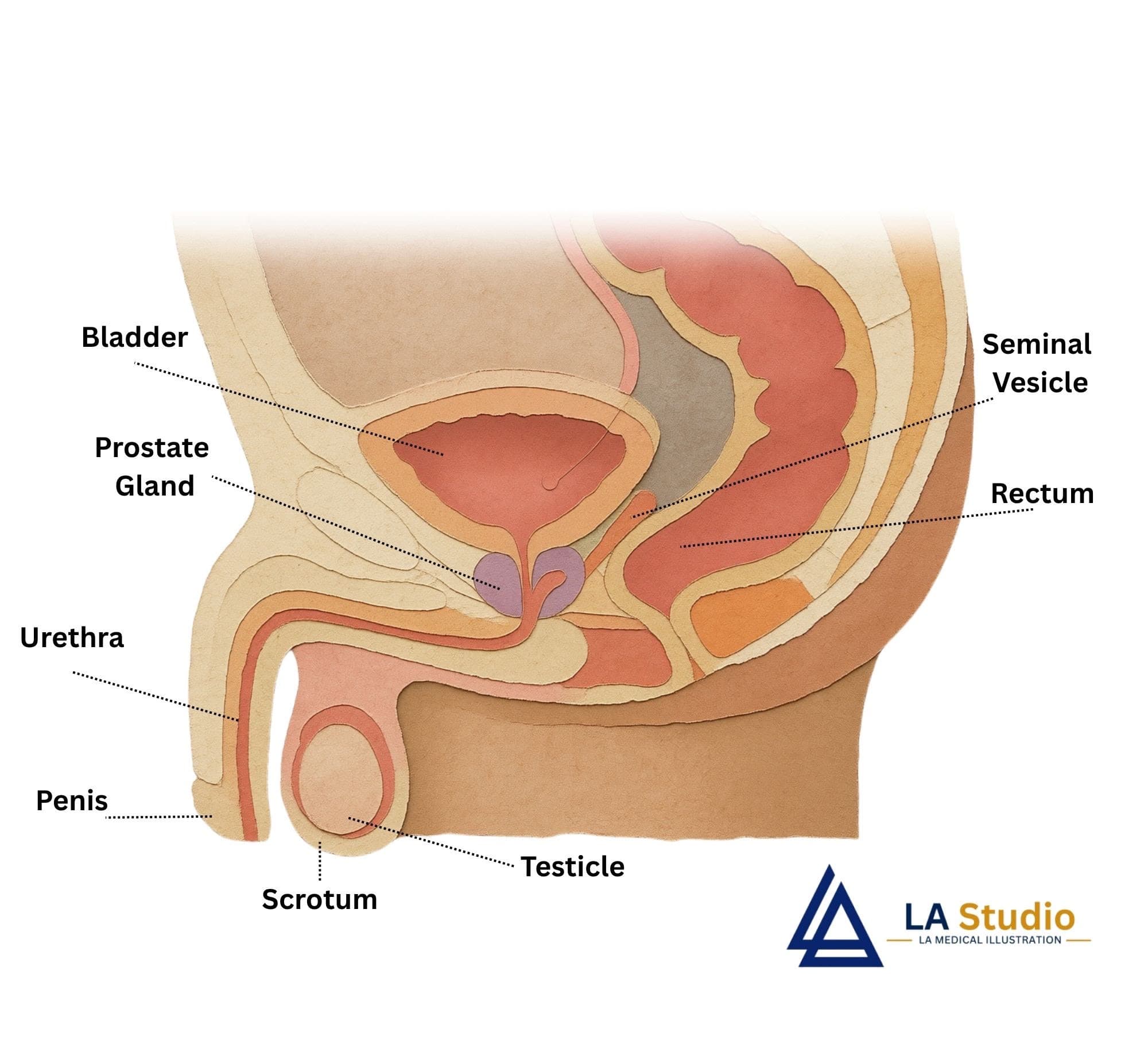
Biopsy anatomy and needle paths

Frequently asked questions
Prostate biopsy questions, answered
How painful is a prostate biopsy?
The experience varies with the transperineal or transrectal route, local anesthetic or sedation, the number of samples, and individual sensitivity. Ask the team to describe its exact pain-control plan and what sensations are expected during and after the procedure.
What are the main prostate-biopsy risks?
Potential risks include bleeding, infection, pain or soreness, and temporary difficulty urinating. The likelihood and prevention plan vary by route and patient factors. Follow the procedure team's instructions and know which symptoms require an urgent call.
Which is better, MRI or prostate biopsy?
Neither replaces the other in every situation. MRI estimates suspicion and helps locate a target; biopsy provides tissue diagnosis. The clinician should explain whether the MRI meaningfully changes the need for biopsy or the sampling plan.
What if a prostate biopsy is positive?
The pathology review should cover Grade Group or Gleason information, involved cores, extent of involvement, and how the findings fit PSA, MRI, and other risk factors. Treatment is not chosen from the word positive alone; the complete risk category and personal priorities matter.
Can a prostate biopsy miss cancer?
Yes. Biopsy samples selected areas rather than the entire gland. MRI targeting and systematic sampling can improve coverage, but a benign result may still require surveillance or additional evaluation when clinical suspicion persists.
Bring these questions
Make the next appointment concrete.
- What specific risk are we trying to clarify with biopsy?
- Which route do you recommend for me, and why?
- What anesthesia or sedation will be used?
- Will samples be MRI-targeted, systematic, or both?
- How will you reduce infection, bleeding, urinary-retention, and pain risks?
- Which symptoms require an urgent call, and what is the after-hours number?
- When will pathology be reviewed with me, and what is the plan for positive, negative, or uncertain findings?
Sources and further reading
These primary references support the educational guide reviewed by Domenico Savatta, MD, FACS on August 23, 2026. They do not replace guidance from your own clinician.
- AUA/SUO Guideline Part II: Prostate Biopsy Considerations (NIH full text)Supports risk-informed biopsy decisions, MRI-targeted and systematic sampling, and use of either transperineal or transrectal routes.
- National Cancer Institute: PSA Test Fact SheetSupports the explanation of PSA limitations and the evaluation pathway that may lead to MRI, additional testing, or biopsy.
- National Cancer Institute: Prostate Cancer TreatmentSupports the role of biopsy tissue, Gleason and Grade Group information, and the need to interpret pathology within the complete diagnosis.
- American College of Radiology: PI-RADSDefines the PI-RADS framework used when MRI findings guide biopsy targeting and risk discussion.
- CMS: Calendar Year 2026 Medicare Physician Fee Schedule Final RuleCurrent Medicare payment-policy context for 2026. It does not establish one person's coverage or final cost.
- CMS: Medicare Physician Fee Schedule Lookup overviewExplains how current code, locality, and payment-policy details can be checked. A lookup result is not an all-in patient quote.
- Medicare: Procedure Price LookupA planning tool for Original Medicare procedure costs. Confirm the exact service, setting, and any separately billed care.
- CMS: What is a Good Faith Estimate?Explains who can request an estimate, why multiple providers or facilities may issue separate estimates, and which services may not appear.
- AUA/SUO: 2026 Early Detection of Prostate Cancer GuidelineCurrent clinical guidance for the decision pathway. It does not make a personal biopsy recommendation on this page.
- Urology Practice: Payments and Patient Cost Sharing for Prostate BiopsiesA historical study of 2009–2015 private insurance claims showing variation by imaging guidance, practice site, and anesthesia. It is not a current price quote.
- Sidecar Health: Prostate biopsy costThe current search-result winner, used only to inspect a published cash benchmark and its exclusions. It is not a quote, coverage determination, or clinical source.