
Quick answers
What to know before the next decision
What is a normal prostate size by age?
In a community ultrasound study of 762 men aged 40 to 70, the mean volume was about 28 mL in the 40s, 31 mL in the 50s, and 35 mL from 60 to 70, with wide spreads around each average. Autopsy data cited by the Baltimore Longitudinal Study of Aging put average weight near 20 g at 40 and about 39 g after 80.
Is 50 cc a large prostate?
It is above the average for every decade in the ultrasound series and above the 40 cc line the Baltimore study used to separate smaller from larger glands. Larger than average does not by itself call for treatment; symptoms, urine flow, residual urine, PSA, and imaging decide the next step.
How is prostate volume calculated?
Most reports multiply length, width, and height and apply a shape constant: π/6, about 0.52, for the ellipsoid formula, or 5π/24, about 0.65, for the bullet formula. The calculator on this page shows both and, if you add a PSA value, the PSA density.
Age-reference chart
Measured prostate volume by decade
Mean transrectal ultrasound volumes with standard deviations from a 2012 community study of 762 men in Shanghai, alongside the autopsy weights cited by the Baltimore Longitudinal Study of Aging. Grams and millilitres are close to interchangeable for prostate tissue. Different populations and methods produce different numbers, so treat these as reference points.
| Age group | Reported average |
|---|---|
| 40 to 49 (ultrasound, 106 men) | 28.2 ± 8.8 mL |
| 50 to 59 (ultrasound, 335 men) | 30.8 ± 9.6 mL |
| 60 to 70 (ultrasound, 321 men) | 35.0 ± 17.4 mL |
| Around 40 (autopsy weight) | about 20 g |
| Over 80 (autopsy weight) | about 39 g |
Use the chart carefully. A single volume does not diagnose anything. Many men above these averages have no symptoms, some below them have significant obstruction, and the same gland can measure differently on ultrasound and MRI or between two operators. Ask how your number was measured before comparing it with a chart.
Choose the moment you are in
Turn the number into one documented next step.
PSA density divides a blood PSA result by prostate volume.
Open guide A PSA result prompted the questionRead PSA levels by ageAge-based PSA reference points and what they can and cannot tell you.
Open guide Urinary symptoms are the real concernStart with urinary symptomsDescribe the pattern and investigate the cause before choosing a treatment.
Open guide An MRI has been ordered or completedUnderstand prostate MRIA prostate MRI can identify suspicious areas, estimate prostate volume, and guide biopsy planning.
Open guide Treatment for enlargement is being discussedCompare BPH proceduresGland size is one of the factors that shapes which procedures fit.
Open guideWhat a normal prostate size looks like at each age
The National Cancer Institute describes the prostate as about the size of a walnut in a man's 20s, slightly larger by 40, and often the size of a lemon by 60. NIDDK describes a second growth phase that begins around age 25 and continues through life. Those descriptions are useful, but they are not measurements, and most online charts that attach a cc range to each decade do not say where the range came from.
The best-sized measured series we could find is a 2012 community study from Shanghai in which 762 men aged 40 to 70 had transrectal ultrasound performed by one examiner. Mean total volume was 28.2 mL in the 40s, 30.8 mL in the 50s, and 35.0 mL from 60 to 70. The standard deviations were 8.8, 9.6, and 17.4 mL, which means the spread inside each decade is wider than the difference between decades. Autopsy data cited by the Baltimore Longitudinal Study of Aging give a longer view: average prostate weight of about 20 g at age 40 and 38.8 g in men older than 80, with microscopic benign enlargement present in about 8% of men aged 31 to 40 and more than 70% by the seventh decade.
Two cautions apply to any chart. The Shanghai men were East Asian community volunteers, and prostate volume differs across populations, so a Western clinic may see somewhat larger averages. And the numbers are averages of measured glands, not definitions of health; a 45 mL prostate at 62 sits inside one standard deviation of the mean for that age group.
How fast the prostate grows, measured rather than assumed
The Baltimore Longitudinal Study of Aging followed 278 men with a median age of 58 who had at least two prostate measurements a median of 4.3 years apart. Median volume moved from 28.1 cc to 31.1 cc. The median rate of change was 0.6 cc per year, or about 2.5% per year, but the range ran from shrinkage of 9.9 cc per year to growth of 62.1 cc per year. Prostate size increased in 61.9% of the men and stayed stable or decreased in 38.1%.
Two findings from that study are easy to miss. Glands under 40 cc at baseline were more likely to grow, 64.6% versus 50.9% for glands of 40 cc or more, and there was no statistically significant correlation between a man's age and how fast his prostate changed. A higher baseline PSA did predict faster growth. In other words, the popular idea that every prostate grows a fixed percentage each year is not what the measurements show.
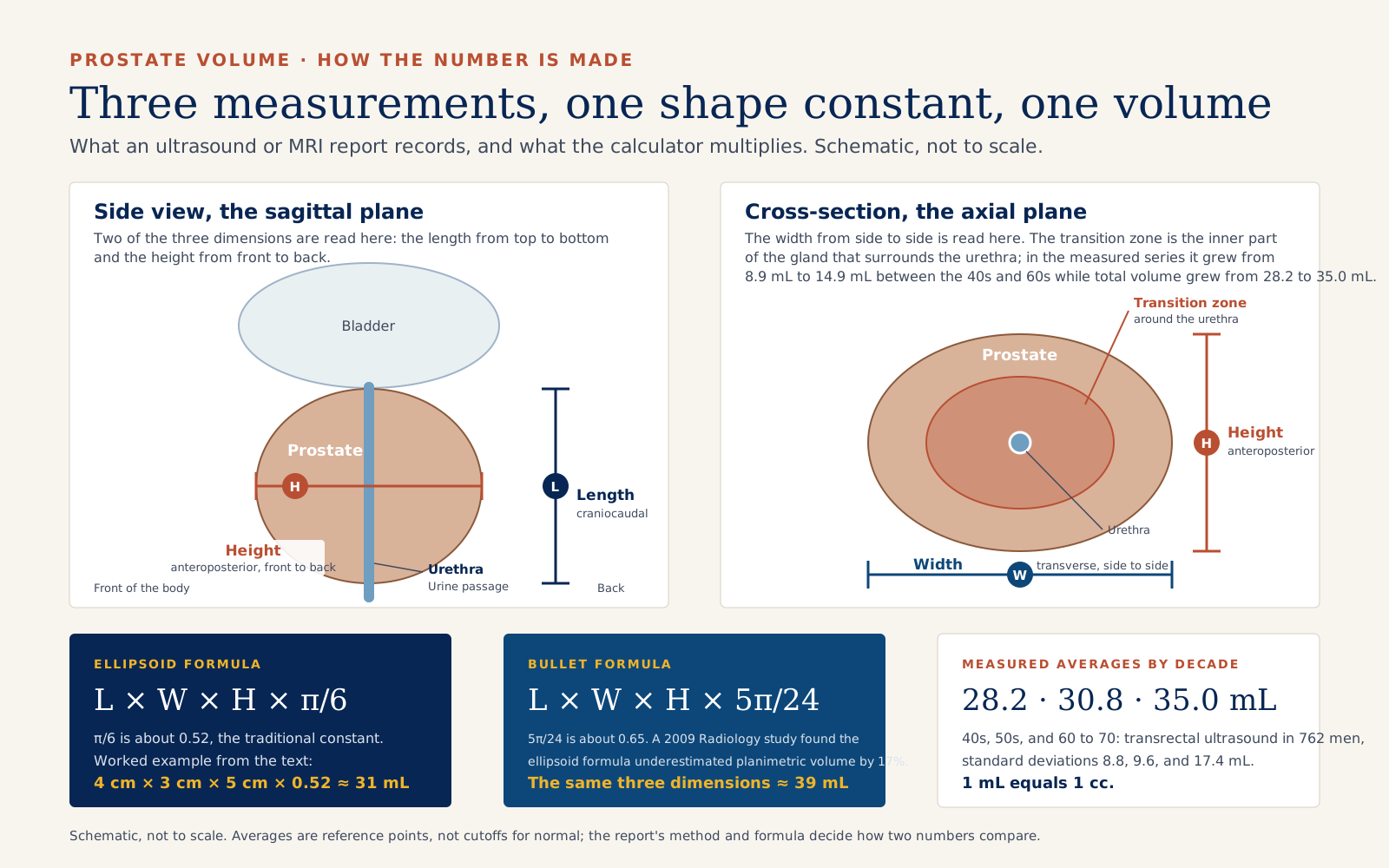
The Shanghai study adds a detail about where the growth happens. Between the 40s and the 60s, mean length grew about 3.6 mm while width grew about 2.2 mm and height about 1.8 mm, and the transition zone, the inner part of the gland that surrounds the urethra, grew from 8.9 mL to 14.9 mL while total volume grew from 28.2 mL to 35.0 mL. The transition zone measurements correlated more closely with urinary symptom scores than total volume did, although all of those correlations were modest.
How prostate volume is calculated from three measurements
Ultrasound and MRI reports rarely measure the whole gland outline slice by slice. They record three dimensions, usually a longitudinal or craniocaudal length, a transverse width, and an anteroposterior height, then multiply them and apply a constant that approximates the shape of the gland. The traditional constant is π/6, about 0.52, which treats the prostate as an ellipsoid. Multiplying 4 cm by 3 cm by 5 cm and then by 0.52 gives about 31 mL.
A 2009 Radiology study of men measured before brachytherapy found that the ellipsoid formula underestimated the planimetric volume by 17% on average, and that a bullet-shaped constant of 5π/24, about 0.65, fitted most glands better, with the largest improvement in prostates under 55 cm³. Some calculators and reports now show both. The same three dimensions give about 31 mL with the ellipsoid constant and about 39 mL with the bullet constant, which is why you should ask which formula a practice uses before comparing two reports.
Units matter as much as the formula. One millilitre equals one cubic centimetre, so mL and cc are the same number. Many reports list dimensions in millimetres; divide each by ten before multiplying, or set the calculator below to millimetres. If a result looks ten or a thousand times too large or too small, the units are the first thing to check.
Interactive model
Turn three measurements into a volume
The urethra carries urine from the bladder through the prostate. The transparent window shows that passage inside the gland, helping explain why enlargement can affect urination. Move the three sliders to change the measurements and watch both volume formulas update. Turn the model, show the transition zone around the urethra, or outline the 4 × 3 × 5 cm example for comparison.
A teaching model of the geometry behind the number, not a measurement of any gland. The calculator below accepts the dimensions from a report; neither it nor this model decides whether a volume is normal.
Browser-only calculator
Prostate volume and PSA density calculator
Type the three prostate dimensions from an ultrasound or MRI report. The estimate is calculated on this page only: nothing you enter is stored, sent to this site, or placed in any record. Add a PSA value if you want the PSA density.
Enter all three measurements to see the estimates.
1 mL equals 1 cc. The two formulas differ because the prostate is not a perfect ellipsoid; ask which formula the reporting practice uses. This calculator does not decide whether a volume or a density is normal, and it does not replace the interpretation of the clinician who ordered the test.Is 40, 50, or 65 cc a large prostate?
The most common searches behind this page are a single number and the word normal. The honest answer is that a volume can be compared with the measured averages, but the comparison does not tell you whether anything needs to be done. The table places common results against the Shanghai decade averages and the Baltimore 40 cc split, and names what usually matters more than the size itself.
A 65 cc prostate is well above every decade average, more than one standard deviation above the mean even for men in their 60s, and would be described as enlarged on most reports. Whether that matters depends on whether it is causing obstruction, retention, bleeding, or bothersome symptoms, and on the PSA density. Some men with 65 cc glands have no symptoms; some men with 30 cc glands have significant obstruction because of where the tissue sits, not how much of it there is.
| Reported volume | Against the measured averages | What usually matters more |
|---|---|---|
| 20 to 30 mL | Around or below the 40s average of 28 mL and the Baltimore baseline median of 28 cc. | Symptoms can still occur at this size; size alone rarely explains them. |
| 30 to 40 mL | Near the 50s average of 31 mL and within one standard deviation of the 60 to 70 average. | Symptom score, flow rate, and residual urine guide any decision. |
| 40 to 60 mL | Above every decade average; the Baltimore study used 40 cc to define its larger-gland group. | PSA density becomes more informative, and enlargement is discussed if symptoms exist. |
| 60 to 80 mL | More than one standard deviation above the 60 to 70 average of 35 mL. | If treatment is considered, gland size can influence which procedures are options. |
| Over 80 mL | Well outside the ultrasound averages; autopsy weights after 80 average about 39 g. | Size shapes procedure choice and imaging planning; it is still not a diagnosis by itself. |
Why prostate size and PSA belong together as PSA density
PSA is made by normal prostate tissue as well as by cancer, so a larger gland tends to produce a higher PSA. PSA density divides the blood PSA by the prostate volume to ask whether the PSA is higher than the size alone would explain. It is one of the inputs guidelines discuss when a clinician decides whether an elevated PSA should lead to MRI or biopsy. The PSA density guide on this site covers how it is interpreted; ask the responsible clinician which value this practice treats as a decision point and which volume measurement was used to compute it.
Because density is a ratio, errors in the volume pass straight through. The ellipsoid and bullet formulas alone move a density by about 20%, and a PSA drawn shortly after ejaculation or vigorous exercise can be temporarily higher, as the National Cancer Institute notes. When two densities disagree, compare the volume method and the timing of the blood draw before concluding that anything changed.
Why the same prostate gets different numbers
A digital rectal exam gives an estimate by touch. Transrectal ultrasound gives three measured dimensions and a formula result. MRI gives dimensions from different planes and sometimes a traced volume. The Baltimore authors note that MRI and ultrasound volumes correlate strongly, with reported correlation coefficients above 0.8, but strongly correlated is not identical, and each method has its own operator variability.
That variability is part of why 38.1% of the Baltimore men appeared to have a stable or smaller prostate at follow-up, a figure that likely mixes true change with measurement noise. Compare like with like: the same modality, the same formula, and ideally the same practice. If a report seems to conflict with an earlier one, ask whether the method changed before asking whether the gland did.
Can an enlarged prostate shrink or go back to normal?
Measured volume does not only move upward. In the Baltimore cohort, more than a third of men had a stable or smaller measurement after a median of 4.3 years. NIDDK lists 5-alpha reductase inhibitors as the medicine class that helps stop the growth of or helps shrink the prostate, and volume reduction is one of the goals of several procedures for benign enlargement. Those are decisions for the treating clinician, made on symptoms and risk rather than on a chart.
We could not find a primary source showing that ejaculation frequency, supplements, or exercise change measured prostate volume. The National Cancer Institute does note that ejaculation and vigorous exercise can temporarily raise PSA, which matters if PSA density is being calculated. Do not start, stop, or change a medicine to move a number on a chart; bring the chart to the visit instead.
Does a large prostate mean cancer?
No. The National Cancer Institute states that an enlarged prostate does not increase a man's risk for prostate cancer, and that BPH and prostatitis are not risk factors for it. Size and cancer risk are separate questions that happen to share one blood test, because both benign enlargement and cancer can raise PSA.
That shared test is why size matters in a cancer conversation. A larger benign gland can explain part of an elevated PSA, which is what PSA density tries to account for, and MRI can estimate volume while also looking for suspicious areas. Cancer can occur in a gland of any size, so a normal or small volume is not reassurance on its own.
When prostate size is not the urgent problem
Volume itself is not an emergency. The complications that sometimes accompany enlargement can be: an inability to urinate, fever with urinary symptoms, heavy bleeding, severe pain, or new back or bone pain with a rising PSA need prompt clinical attention regardless of what any chart says about the size.
For everything else, the useful next step is a written plan. Ask what the volume changes about your follow-up, what result or symptom should trigger earlier review, and who owns that follow-up.
Frequently asked questions
Prostate size by age, answered carefully
What is normal prostate volume by age?
In a 2012 ultrasound study of 762 community men, mean volume was 28.2 mL at 40 to 49, 30.8 mL at 50 to 59, and 35.0 mL at 60 to 70, with standard deviations of roughly 9 to 17 mL. Autopsy data cited by the Baltimore Longitudinal Study of Aging give about 20 g at age 40 and about 39 g after 80. Averages are reference points, not cutoffs for normal.
Is 50 cc a large prostate?
A 50 cc prostate is above the measured average for every decade from the 40s to the 60s and above the 40 cc line the Baltimore study used for its larger-gland group, so most reports would call it enlarged. Enlarged is a description, not a treatment decision; symptoms, flow, residual urine, PSA density, and imaging decide what happens next.
Is a 65 cc prostate volume normal?
It is well above the measured averages and more than one standard deviation above the mean for men in their 60s. That makes it enlarged by comparison, but not automatically a problem. Ask whether it is causing obstruction or symptoms, what the PSA density is, and whether the size affects which treatments would be options if any were needed.
What is the volume of an enlarged prostate?
There is no single cutoff. Studies and reports use different lines, and the Baltimore aging study split its cohort at 40 cc. What clinicians act on is whether the gland is causing obstruction, retention, bleeding, or bothersome symptoms, and how its size interacts with PSA and treatment choices.
How do you calculate the volume of the prostate?
Multiply the three measured dimensions, length, width, and height, then multiply by a shape constant: π/6, about 0.52, for the ellipsoid formula, or 5π/24, about 0.65, for the bullet formula. Measurements in millimetres should be converted to centimetres first. One millilitre equals one cubic centimetre.
Can an enlarged prostate go back to normal?
Measured volume can stay stable or decrease. In the Baltimore cohort, 38.1% of men had a stable or smaller prostate after a median of 4.3 years, and NIDDK lists 5-alpha reductase inhibitors as medicines that help stop growth or shrink the gland. Whether any of that applies to you is a decision for the treating clinician.
Does ejaculating help an enlarged prostate?
We could not find a primary source showing that ejaculation changes measured prostate volume. The National Cancer Institute does note that ejaculation can temporarily raise PSA, which matters if a PSA density is being calculated soon afterward.
What is a high PSA for a 70-year-old man?
AUA/SUO guidance notes a commonly quoted age-varying threshold of about 6.5 ng/mL in the 70s, but no cutoff is diagnostic. Prostate size is one reason PSA rises with age, which is why PSA density and prior values matter more than a single number. The PSA levels by age guide on this site covers the details.
What size of prostate is dangerous?
No volume is dangerous by itself. The dangers associated with enlargement, such as urinary retention, bladder or kidney effects, infection, and bleeding, come from obstruction and its complications, which correlate imperfectly with size. Inability to urinate, fever with urinary symptoms, or heavy bleeding needs prompt care at any prostate size.
Bring these questions
Make the next appointment concrete.
- Which method measured my prostate volume, exam, ultrasound, or MRI, and which formula was used?
- How does this volume compare with my prior measurements on the same method?
- What is my PSA density, and which value does this practice use as a decision point?
- Are my symptoms, flow rate, and residual urine consistent with the size, or is something else going on?
- If treatment for enlargement is discussed, does my gland size change which options fit?
- What result or symptom should trigger earlier review, and who owns that follow-up?
Sources and further reading
These primary references support the educational guide reviewed by Domenico Savatta, MD, FACS on September 5, 2026. They do not replace guidance from your own clinician.
- Zhang SJ et al. Relationship between age and prostate size. Asian Journal of Andrology 2013;15(1):116–120 (NIH full text)Transrectal ultrasound volumes and dimensions by decade in 762 community men aged 40 to 70; the source of the decade averages in the chart.
- Loeb S et al. Prostate volume changes over time: results from the Baltimore Longitudinal Study of Aging. Journal of Urology 2009;182(4):1458–1462 (NIH full text)Median growth of 0.6 cc or 2.5% per year, the share of men whose prostate grew or did not, the 40 cc split, and the autopsy weights it cites.
- MacMahon PJ et al. Modified prostate volume algorithm improves transrectal US volume estimation in men presenting for prostate brachytherapy. Radiology 2009;250(1):273–280 (PubMed)Reports that the ellipsoid formula underestimated planimetric volume by 17% on average and proposes the bullet-shaped constant, with the largest gain in glands under 55 cm³.
- National Cancer Institute: Understanding Prostate Changes and ConditionsWalnut-to-lemon description of size with age and the statement that an enlarged prostate does not raise prostate cancer risk.
- NIDDK: Enlarged Prostate (BPH)Second growth phase from about age 25, BPH prevalence estimates by age, and the role of 5-alpha reductase inhibitors in slowing or shrinking the gland.
- National Cancer Institute: PSA Test Fact SheetFactors such as ejaculation and vigorous exercise that can temporarily raise PSA, which matters when PSA density is calculated.
- Hari Sawkar, MD: Prostate Size Chart by AgeThe current leading U.S. organic result inspected for its uncited decade ranges, everyday-object comparisons, and treatment framing.